Forest Carbon Field
Landowners are paid to protect their forests, with the land’s environmental value measured in carbon credits. Calculating this requires field reps to accurately measure tree dimensions, a skill passive training struggles to teach. When reps know the theory but fail the on-site execution, conservation groups risk flawed data and lost funding.
Developed for The Nature Conservancy in just one week, the Forest Carbon Estimator solves this by replacing static reading with a functional data-entry simulation. Embedded inside Articulate Rise, the module trains users on a fully offline, downloadable web app built with a human-centered design. The result is a dual-purpose prototype: it turns abstract environmental concepts into measurable field competence, while giving reps an actual field-ready tool that exports JSON, CSV, and JPEG data to calculate a land’s true value.



The challenge
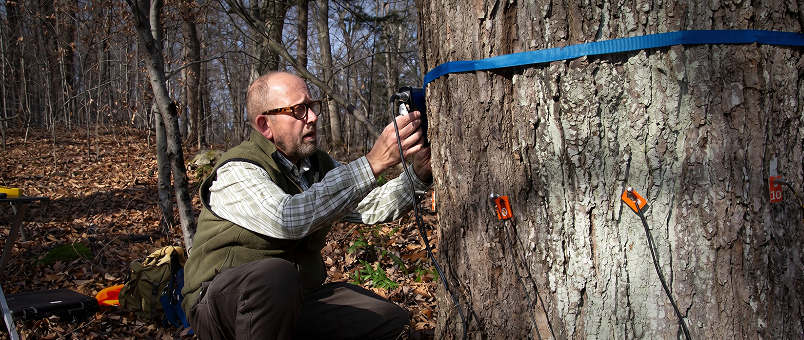
Carbon credit valuation is where conservation funding is won or lost. The financial and environmental impact of a protected forest depends entirely on how accurately field reps measure tree dimensions. Small miscalculations stack up fast, resulting in compromised data and lost revenue.
In practice, the biggest pain point isn’t understanding what carbon is. It’s executing the measurement under strict field constraints. Reps are often blocked by the complexity of traditional scientific tools, steep technical learning curves, and tight project budgets. Measuring a 10×10 meter plot requires a level of precision that rural or newly onboarded reps often lack, and a single bad dataset can invalidate an entire land assessment.
This gets harder when standard training relies on passive instruction. You cannot learn to measure a forest by clicking through a slide deck. The challenge was to solve this execution gap—and build a fully functional, human-centered prototype—in just one week. The goal wasn’t to assign more theory, but to strip away the complex scientific barriers and give reps realistic, accessible practice that completely bypasses the need for expensive equipment.
Designing a solution
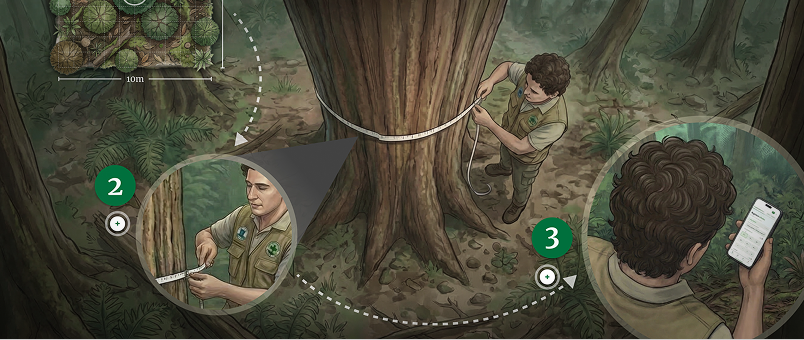
The strategy: tool-driven practice over passive theory I designed the Forest Carbon Estimator to move beyond standard knowledge checks. It acts as both a training simulator and a deployable field tool, stripping away the complexity of traditional scientific equipment. This gives learners a safe sandbox to practice data entry and make mistakes without the real-world consequence of invalidating an actual land assessment.
The mechanics: hybrid architecture and field utility To solve the dual challenge of cognitive load and remote field constraints, I bypassed standard eLearning limitations. Instead of a basic quiz, I embedded a custom web app directly inside the course structure:
Stage 1 (Context): Ground the learner in the mechanics of carbon valuation and the rules of the 10×10 meter plot methodology.
Stage 2 (Simulation): Allow learners to practice logging tree height and diameter directly into the embedded app, receiving immediate feedback on their measurement logic.
Stage 3 (Field Deployment): Provide the exact same app as a downloadable, fully offline mobile tool that exports JSON, CSV, and JPEG data, ensuring reps can operate deep in a forest without an internet connection.
This structure turns abstract onboarding into a tangible, deployable workflow. The human-centered UI was specifically tuned to ensure that rural field reps with limited technical backgrounds could navigate it intuitively and flawlessly.
My role I executed the end-to-end product development under a strict one-week deadline. I owned the needs analysis, instructional strategy, UX flow, and the custom HTML/JS development, ultimately proving how to integrate a functional, offline-ready web app directly into Articulate Rise.
The result

The impact: Validating the hybrid model We moved beyond standard static modules to deliver a deployable, offline-ready tool. The Forest Carbon Estimator proves that technical field skills can be trained and executed within the same digital ecosystem. It shifts the focus from simple course completion to measurable field competence, ensuring reps generate accurate, revenue-critical data on their first try instead of just passing a multiple-choice quiz.
The reach: Built for remote execution Designed specifically for the realities of environmental field work, the app operates completely independent of an internet connection. Its human-centered UI ensures that rural reps with varying technical backgrounds can navigate it flawlessly on mobile devices. By allowing users to save and export critical data as JSON, CSV, and JPEG files directly from the field, the tool instantly bridges the gap between training and real-world application.
The architecture: Bypassing authoring constraints Built and deployed in just one week, the architecture relies on a custom HTML web block embedded seamlessly inside Articulate Rise. This approach breaks the limitations of out-of-the-box authoring tools. The framework is highly modular, meaning the core data-entry engine can be rapidly repurposed for other field data collection needs without rebuilding the logic. It is not just a single training module; it is a scalable blueprint for embedding functional web apps into standard L&D environments.
Project screengrabs



Looking for this level of quality?
I help teams build scalable, effective and engaging learning solutions. I’m currently available for new opportunities.