Service Star Challenge
Traditional customer service training teaches empathy and policy in a vacuum, but the reality of the job requires executing both under live fire. This creates a gap where learners know what to say in theory, but fail to execute it when faced with an angry customer, a complex policy, and a ticking clock.
Service Star Challenge bridges this gap by replacing passive role-play with a high-stakes, decision-making simulation. Built with a dynamic “Mood Matrix” and an ever-ticking timer, it is a gamified framework that forces learners to execute complex support protocols and de-escalation tactics in a risk-free environment.



The challenge
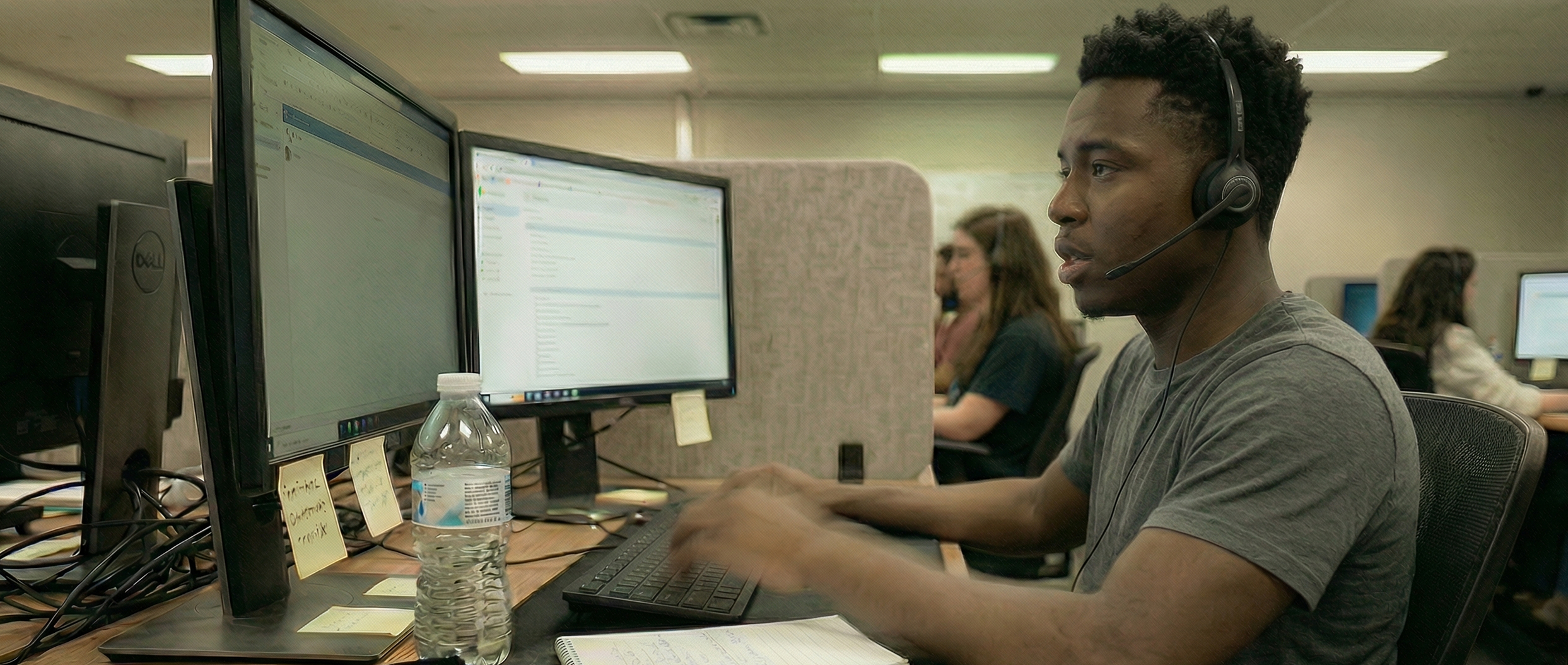
High-volume call centers notoriously battle annual turnover rates upwards of 45%, largely driven by the stress of live customer interactions. Every escalated call or botched resolution negatively impacts CSAT (Customer Satisfaction) scores and bleeds company resources.
The user reality: The multitasking friction
The job of a support rep is intensely demanding. They must actively listen to a frustrated client, rapidly search a database for the correct policy, and formulate an empathetic response, all while a timer counts down. Standard training does not simulate this cognitive load.
The villain: “Cringe” role-play Traditional customer service training relies on static PDFs and awkward, scripted peer-to-peer role-plays. It feels inauthentic to a digitally native workforce. It fails to simulate the actual pressure of the floor, leaving new hires overwhelmed the moment they take their first real call.
Designing a solution
The Strategy: Situated Learning & Empathy Under Pressure
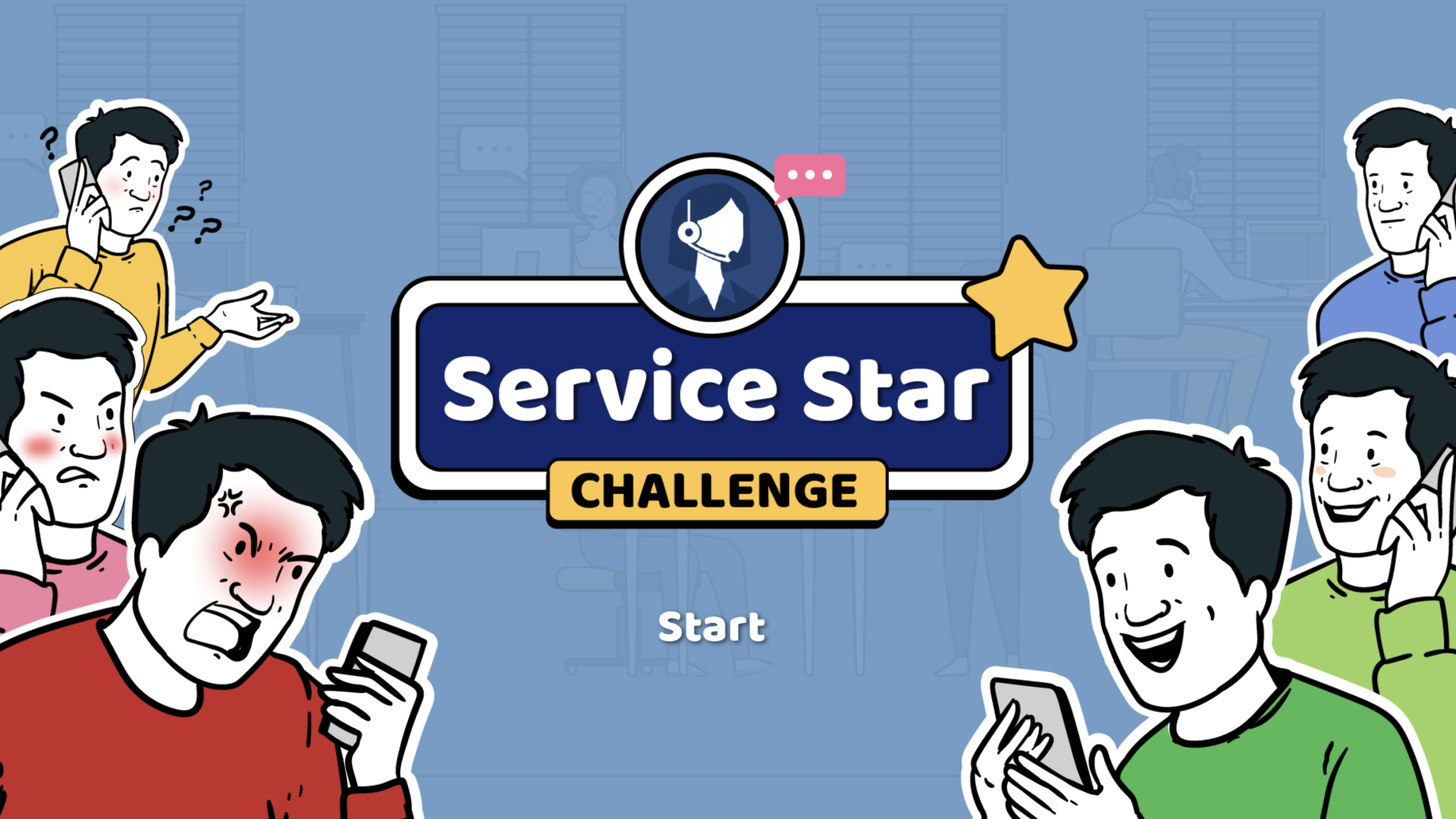
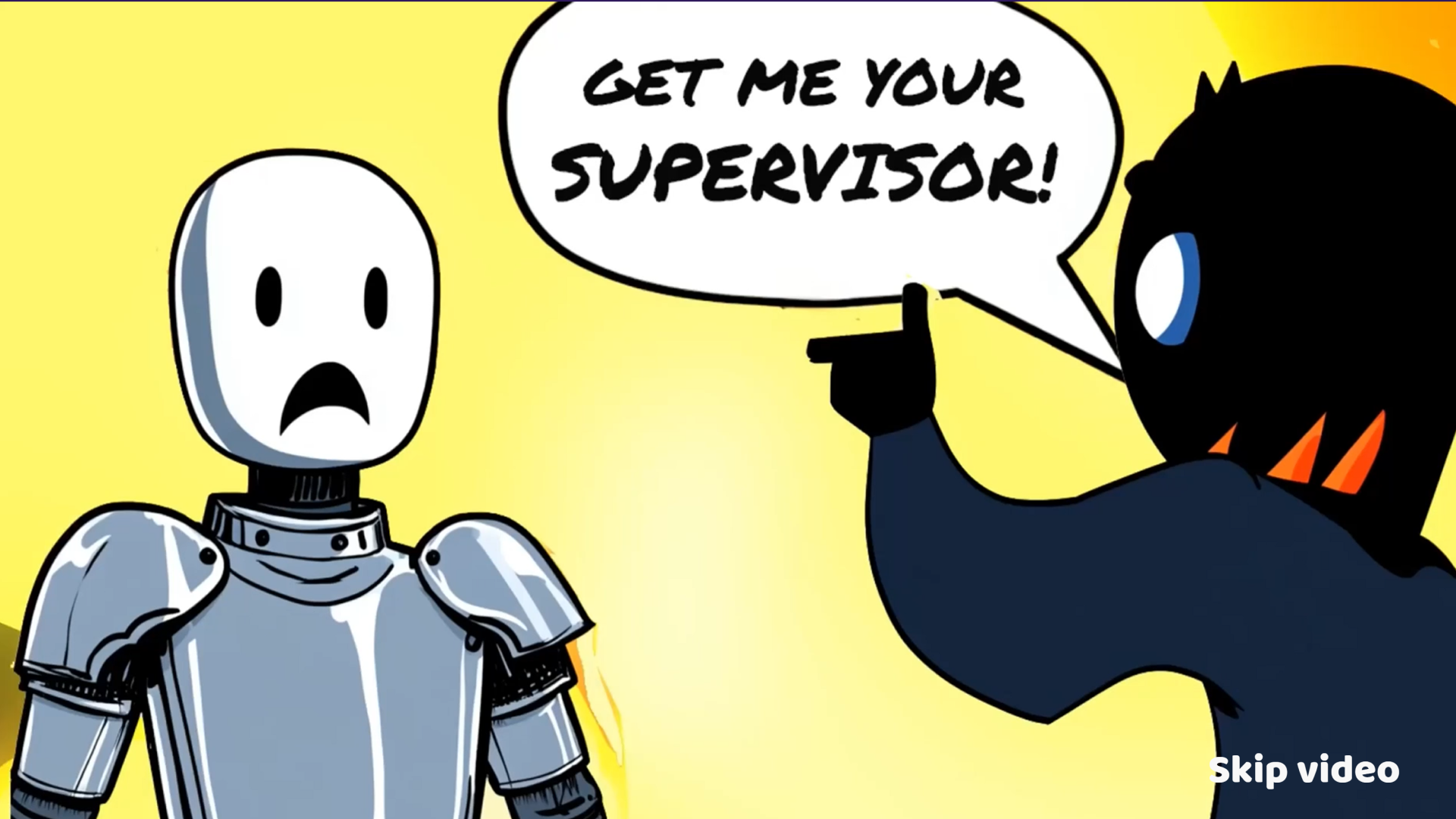
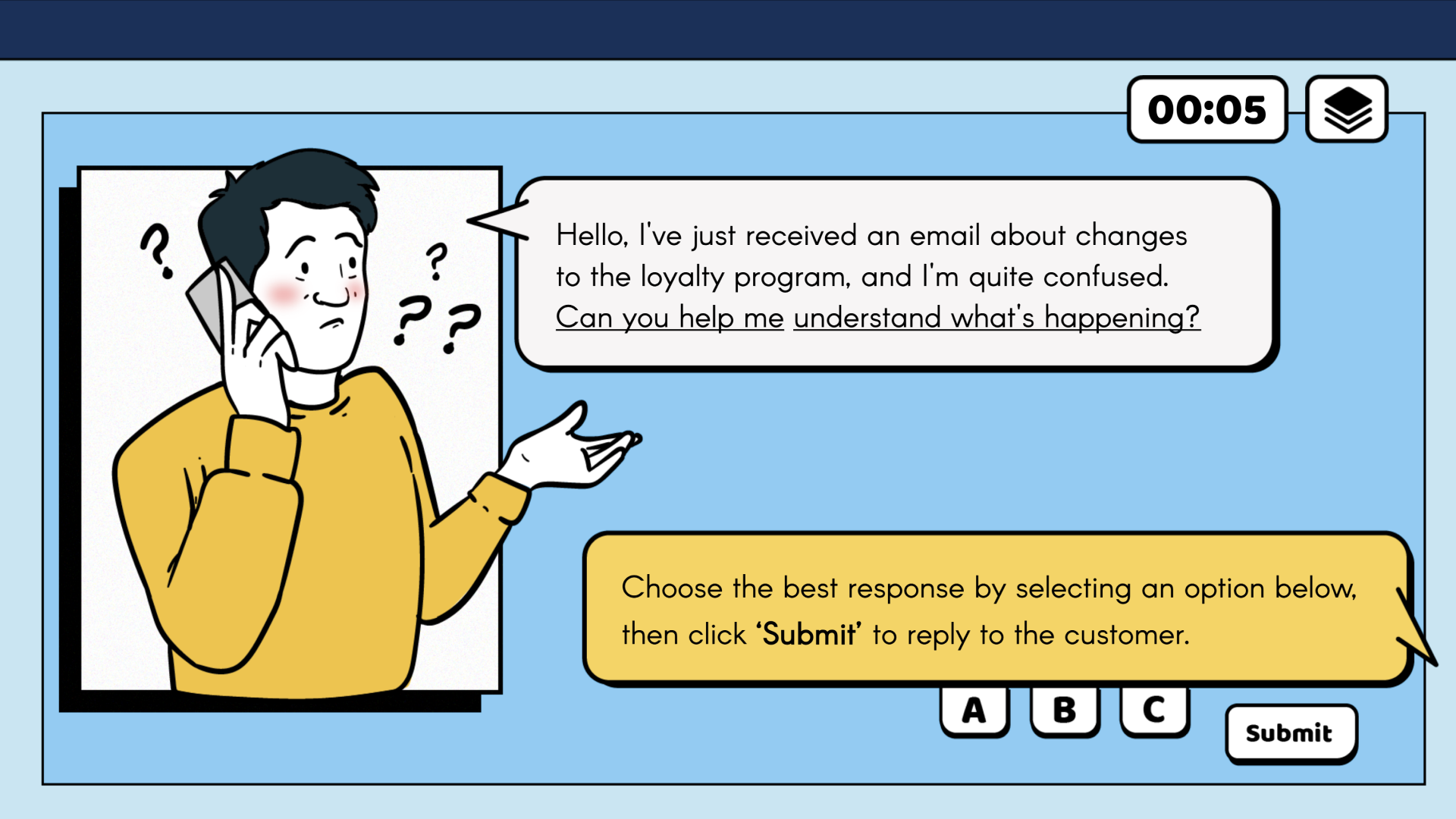
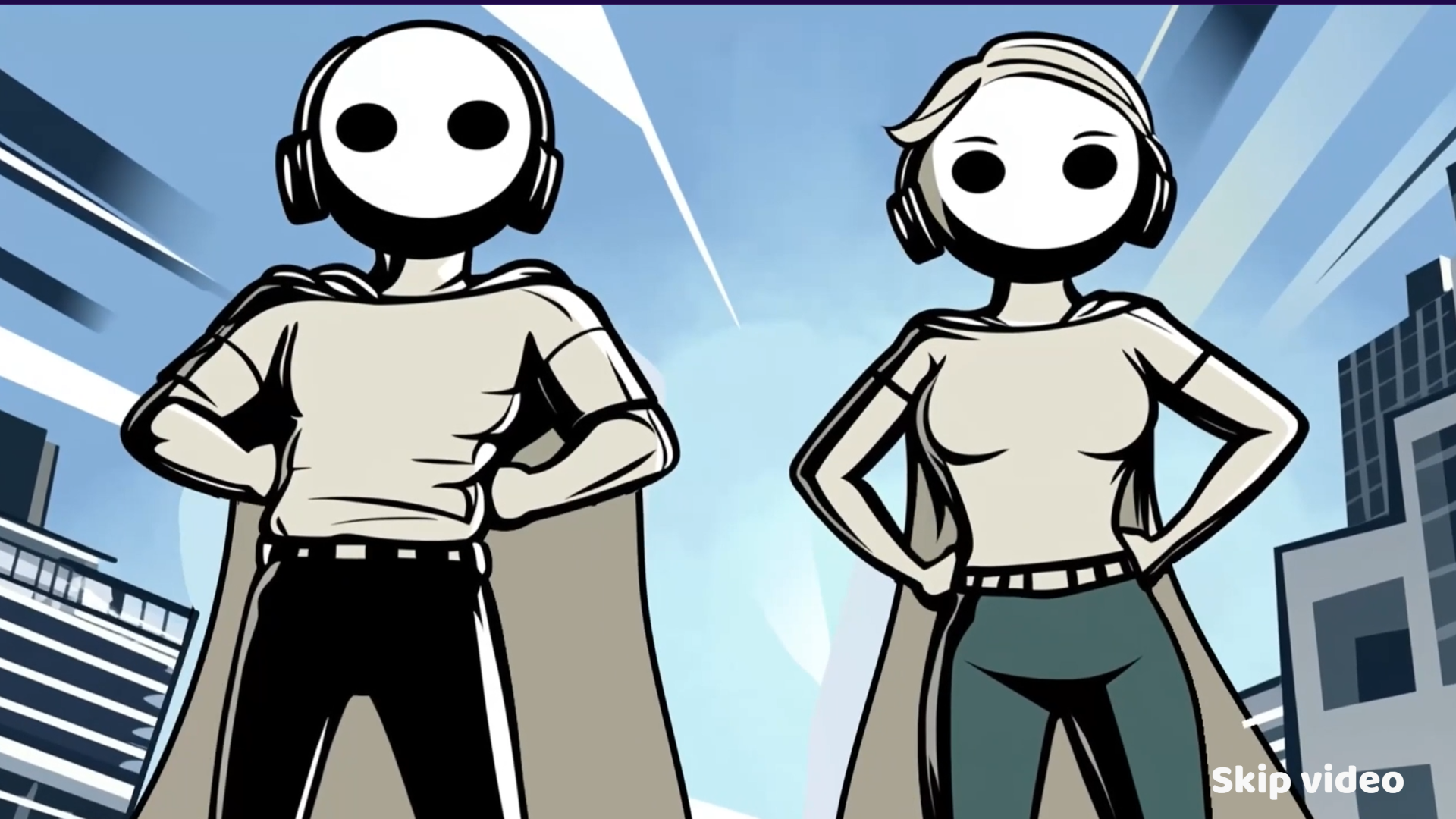
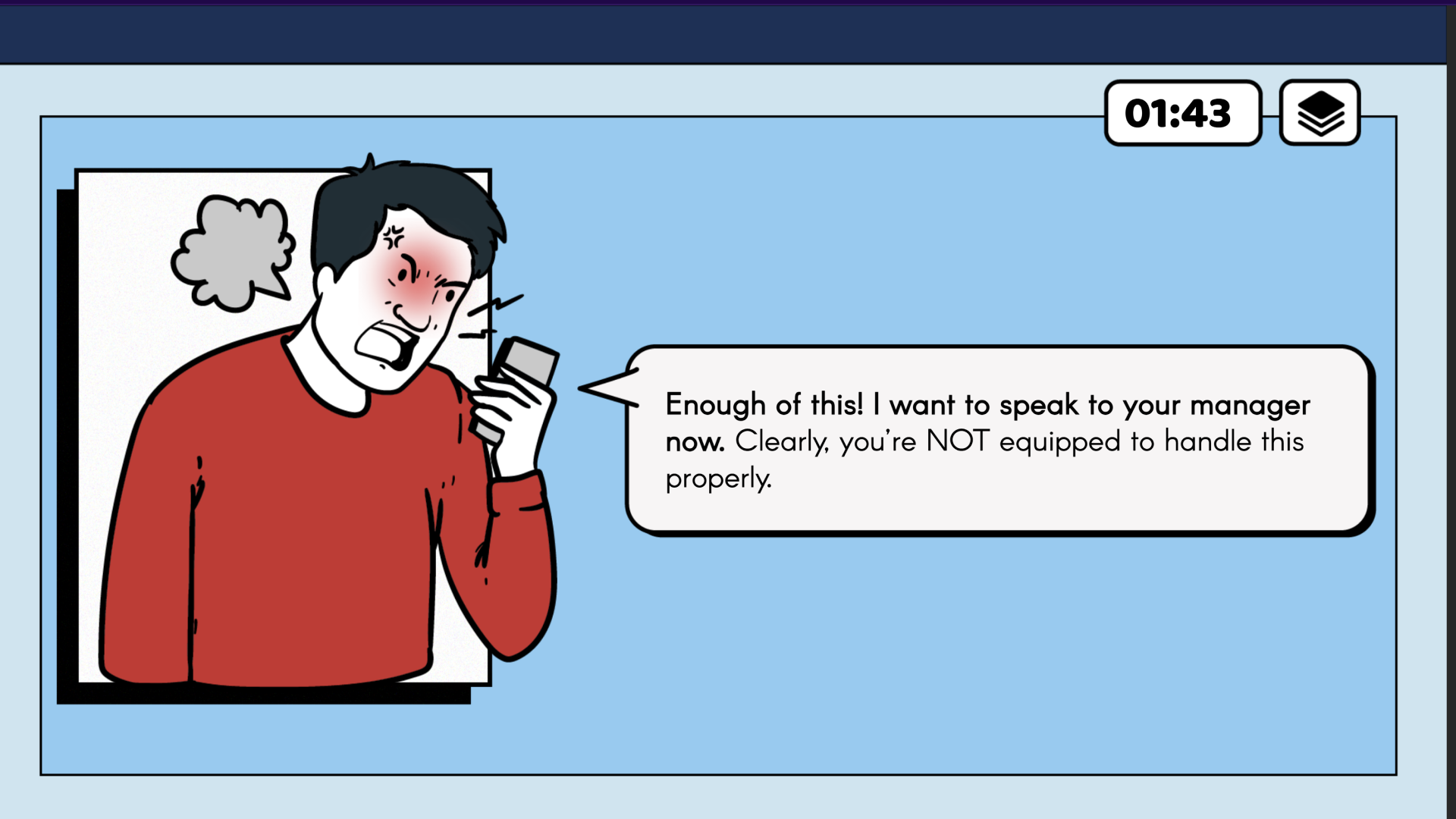
To deeply engage a younger demographic, I architected a simulation that borrows heavily from AAA gaming and anime aesthetics (reminiscent of League of Legends). By using bold comic-book UI, animated cinematic intros, and professional voice acting, we framed the training not as a “module,” but as a high-stakes challenge.
The Mechanics: Scaffolding the Live Call
I designed the simulation to mimic the exact multitasking friction of a live support environment through three core mechanics:
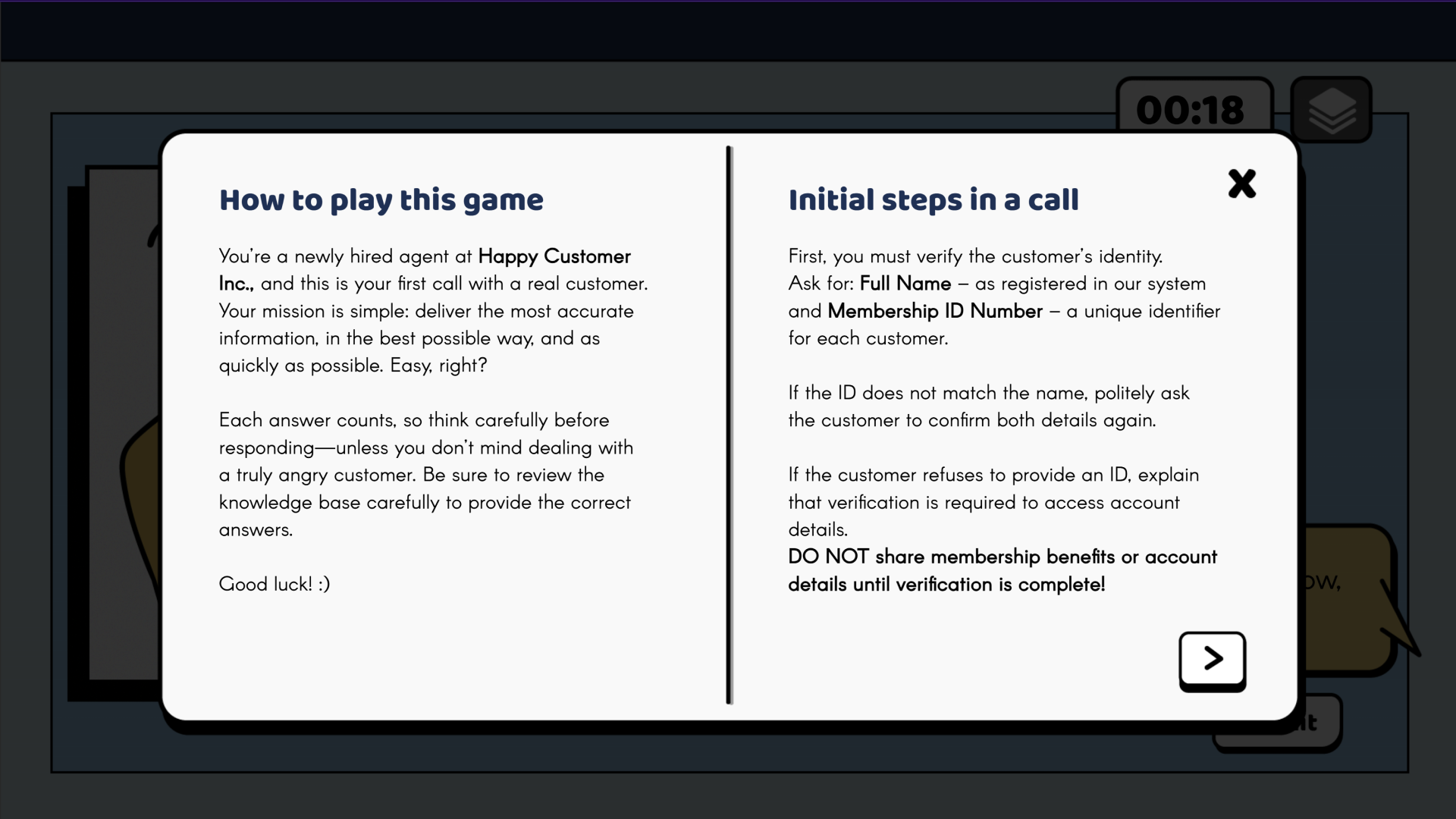
Stage 1 (The Hook): A humorous, high-energy cinematic animated intro establishes the context and the rules of engagement, immediately capturing the learner’s attention before the simulation begins.
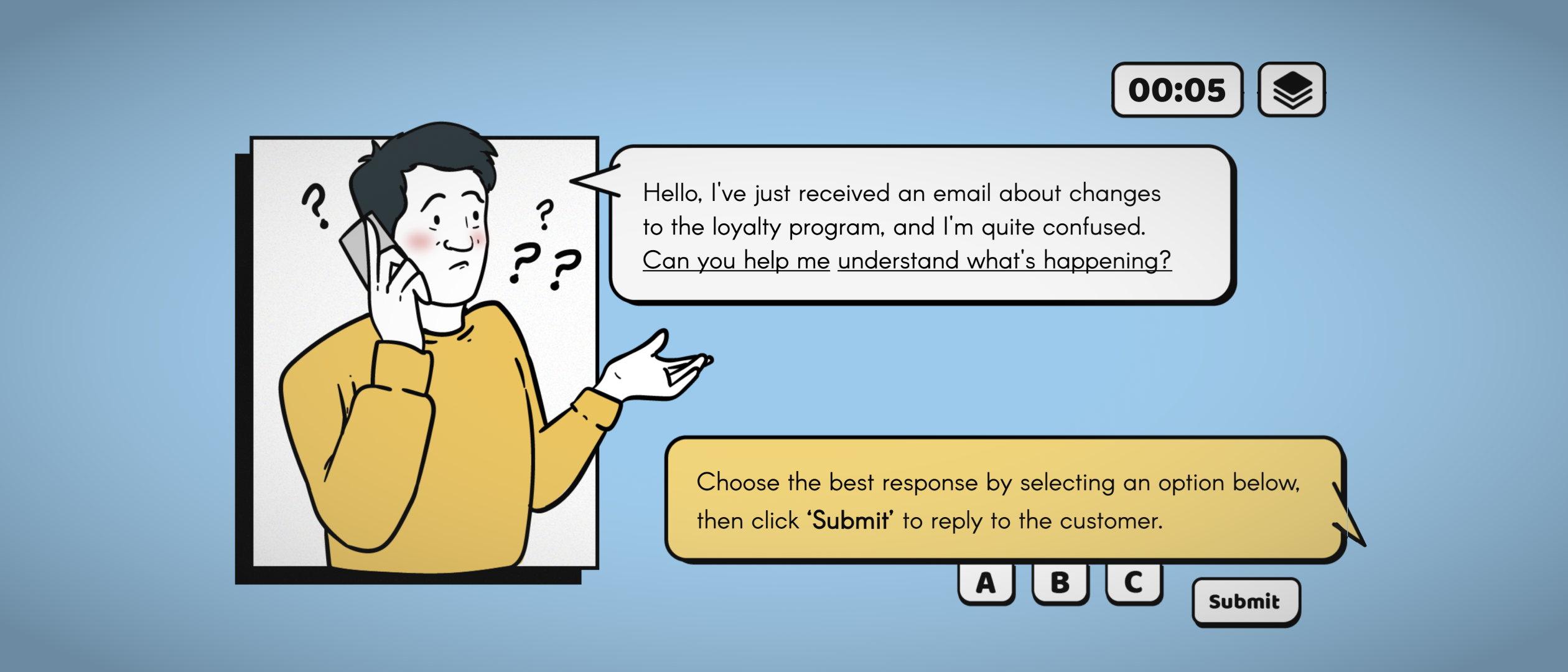
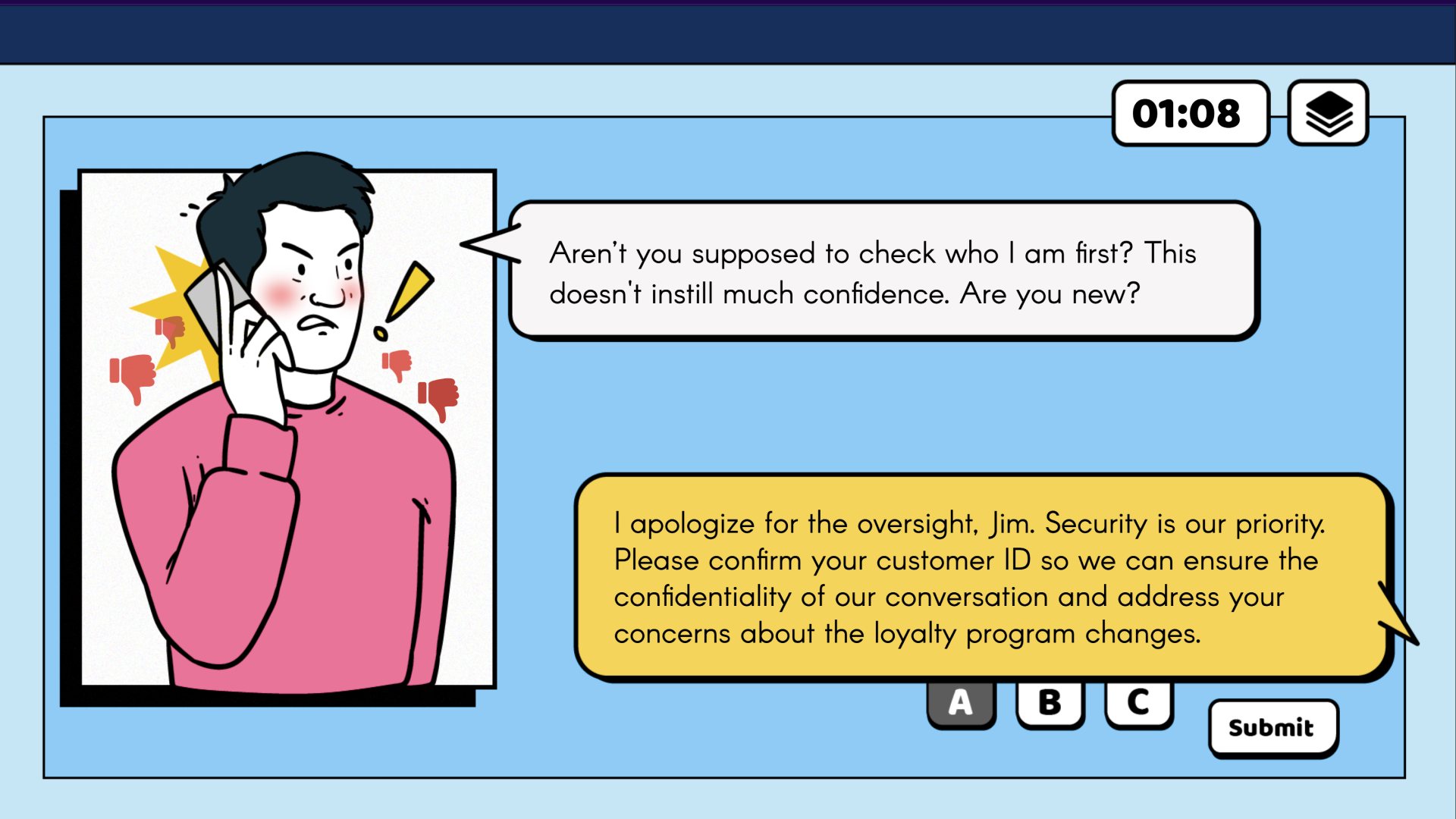
Stage 2 (Live-Fire Application): Learners must search a pop-up Knowledge Base to find correct policy answers. Crucially, the timer never stops while they read, forcing them to scan, interpret, and apply information rapidly—just like a real call.
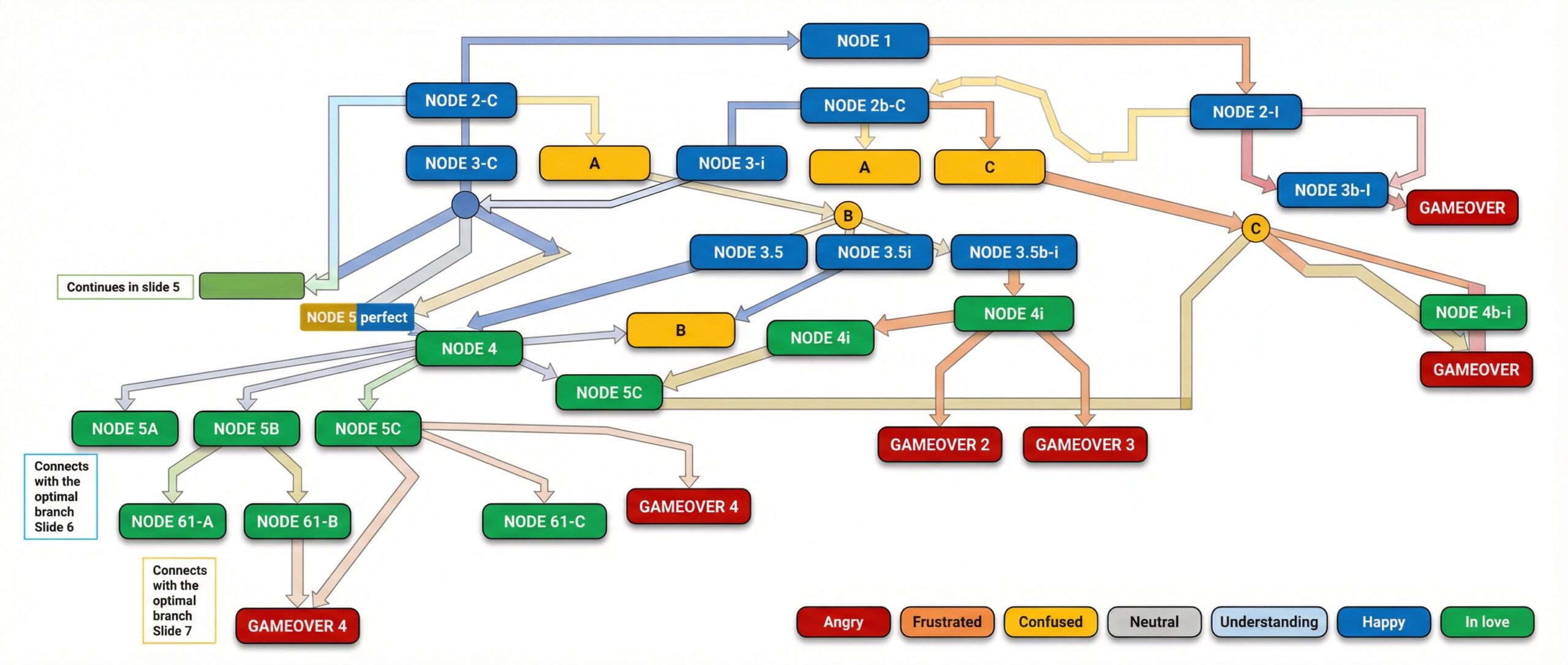
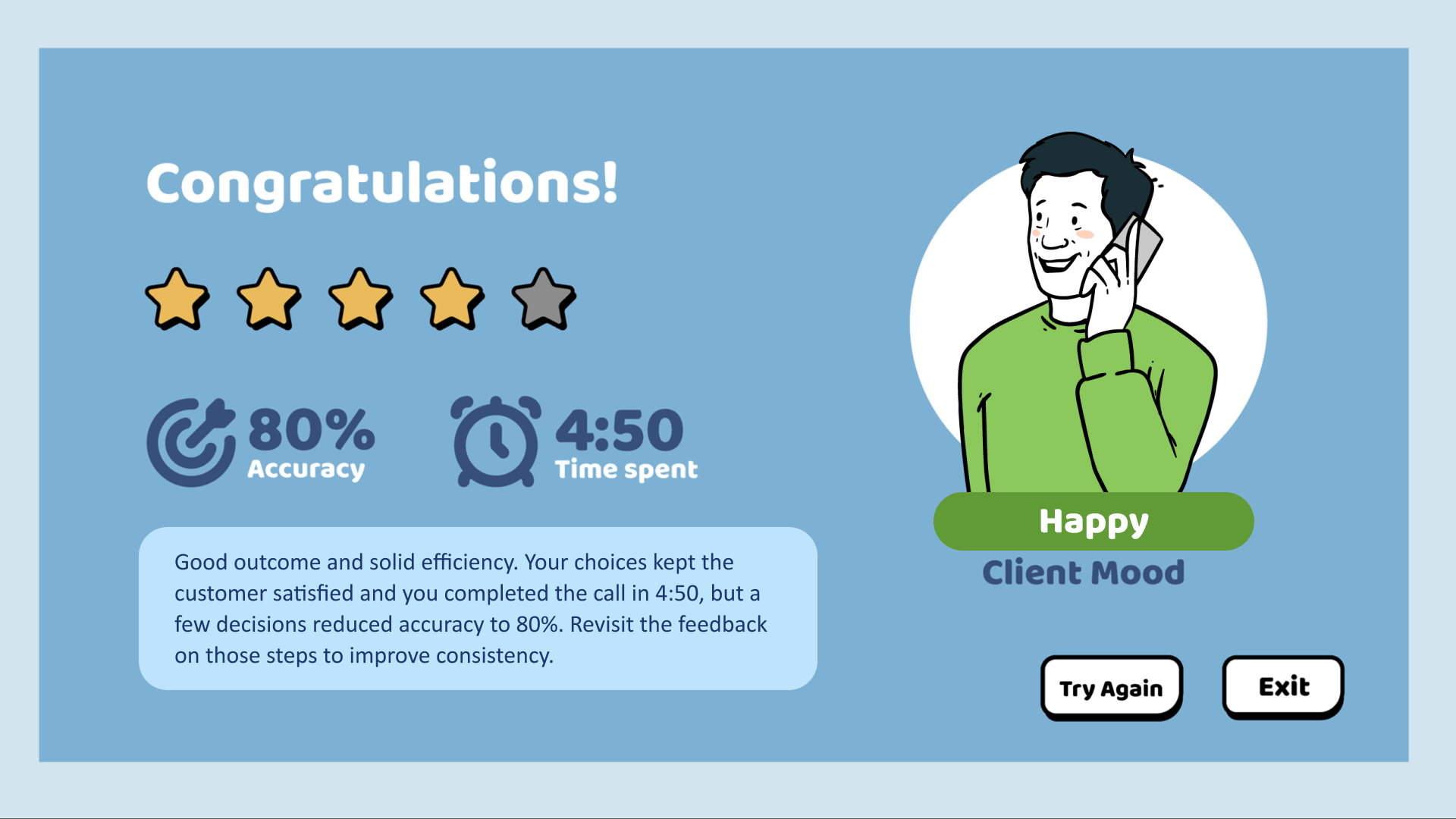
Stage 3 (The Mood Matrix): I engineered a complex, 7-state branching logic system (ranging from Angry and Frustrated to Neutral and Delighted). Every dialogue choice the learner makes directly impacts the customer’s visual “Mood Bar” and the voice actor’s tone, providing immediate, visceral feedback on their de-escalation skills.
My Role & Creative Direction
I operated as the end-to-end Creative Director and Lead Developer for this project. I managed a cross-functional team—directing a professional voice actor to capture the 7 distinct emotional states, guiding an animator for the cinematic sequences, and leading a graphic designer to nail the comic-book UI. Finally, I brought all these assets together by programming the complex branching variables, timers, and knowledge-base triggers entirely within Articulate Storyline.
The result
The impact: Measurable Soft Skills
From Passive to Active: Shifted customer service training from memorizing scripts to validating actual behavioral judgment under stress.
Realistic Stress Testing: The relentless timer combined with the real-time “Mood Bar” proved that soft skills and empathy can be stress-tested and measured in a digital environment.
High-Fidelity Engagement: The AAA-gaming aesthetic and professional voice acting successfully captured the attention of a demographic prone to training fatigue.
The reach: Built for the Frontline
Role-Agnostic Application: While stylized, the core mechanics of searching a knowledge base and de-escalating frustration are universal, making it deployable across various BPO campaigns.
Accessible Challenge: The simulation balances difficulty perfectly; it is hard enough to feel like a true “Challenge,” but intuitive enough that the software never gets in the way of the learning.
The architecture: A Deep Branching Engine
Variable-Driven Storyline: Architected a deep branching logic framework within Storyline that tracks multiple states (Time, Mood, Score) simultaneously.
Scalable Engine: The underlying mechanics—the pop-up Knowledge Base, the 7-state Mood Bar, and the timer—form a reusable engine. The business can easily swap out the script, voice audio, and policy PDFs to simulate entirely new call types without rebuilding the technical foundation.
Project screengrabs

Looking for this level of quality?
I help teams build scalable, effective and engaging learning solutions. I’m currently available for new opportunities.